


Chances are you've heard the term padel somewhere in 2021. Padel is the fastest growing sport in the Netherlands. But what exactly is padel? We'll explain it to you in this blog!
About padel
Padel is a racket ball sport played by four people. Padel is played on a court surrounded by a cage. The padel ball is similar to a tennis ball but is slightly softer. The aim is to get the ball over the net, with the cage also playing an important role. Many people consider padel to be a combination of tennis and squash. To give you a better idea of the sport, we will explain the rules.
The padel court
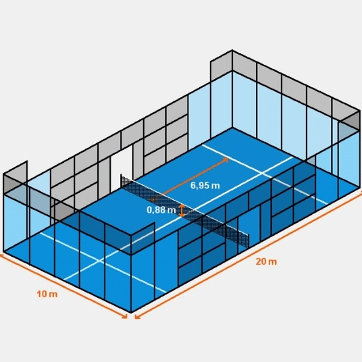
It is not wrong to say that padel resembles a combination of tennis and squash. However, there are a number of important differences. To begin with, the padel court is a lot smaller than a tennis court. The dimensions of a padel court are 20 by 10 meters (see images below). In addition, a padel court does not have walls like a squash court. The cage is a combination of fencing and glass. The padel court consists of two playing halves, each with two service boxes and a backcourt. The two halves are separated by a net, just like in tennis.
Padel rules
The rules of padel are very similar to those of tennis. The padel ball must always be hit over the opponent's net. In padel, the serve is played underhand, with the ball first bouncing behind the service line. In padel, it is also allowed to let the ball bounce against the wall after it has bounced. You can then hit it back. This often results in surprising and unique rallies.
Scoring
The scoring in padel is the same as in tennis, namely 15, 30, 40 (possibly deuce) and game. If you reach deuce, two consecutive points must be scored to win the game. You do this by using the advantage/disadvantage rule.
Padel matches are often played to the best of three sets. You win a set when your team is the first to win six games with a two-game difference. If the score is 6-6 in games, you play a tiebreak. You play a tiebreak until one of the teams has seven points with a two-point difference from the other team. Both teams have won a set? Then you play a third set. This is played in the form of a super tiebreak, which is similar to the regular tiebreak. However, you play to ten points with a two-point difference, instead of seven points.
The origins of padel
The story goes that padel originated in Acapulco, Mexico, in 1969. Its inventor was Enrique Corcuera, a wealthy Mexican businessman. He came up with a new sport by adapting the rules, rackets, and dimensions of tennis. He built the first padel court in his own front yard. Through a Spanish friend of Enrique's, padel then made its way to Spain, where the first European padel club was founded. From that moment on, padel began to grow enormously in Spain. Argentina soon followed, after which other countries began to follow suit. In the Netherlands, there are currently more than 500 padel courts at 200 different locations. It is expected that by 2024 there will be 1,100 padel courts at around 400 locations.


Leave a comment
This site is protected by hCaptcha and the hCaptcha Privacy Policy and Terms of Service apply.